
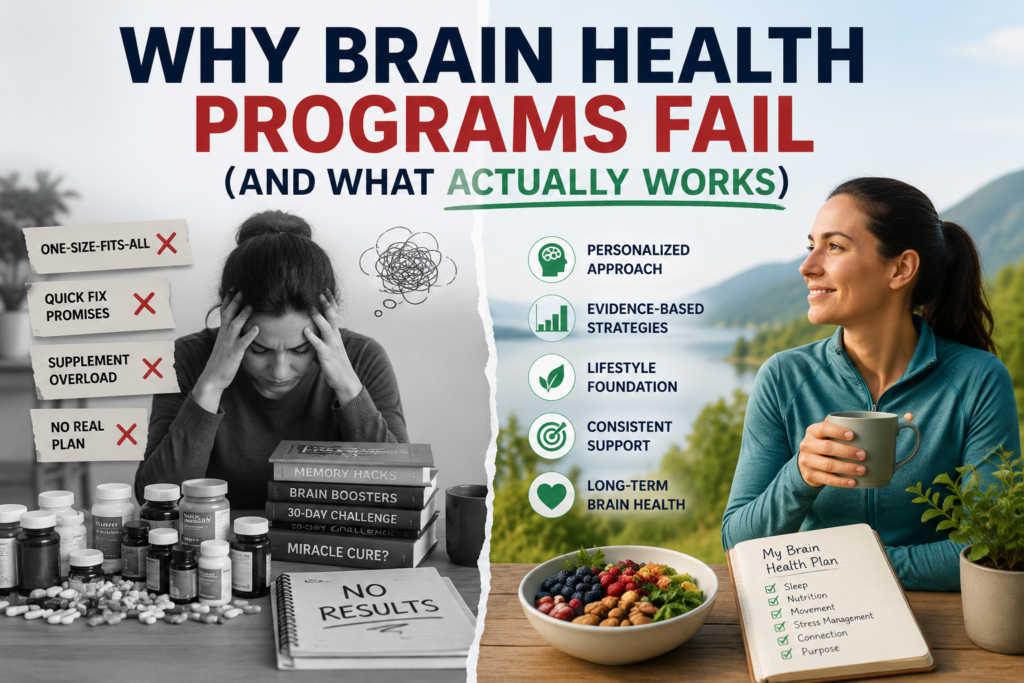
Most brain health programs give you one tool and expect it to fix everything.
A teen struggles with focus, so they get medication. An adult battles brain fog, so they try supplements. An older adult worries about memory, so they do crossword puzzles.
The problem isn’t that these interventions are wrong. The problem is that your brain doesn’t work in isolation.
Your brain is a biological system that depends on electrical regulation, physical movement, emotional processing, and cellular nutrition. When you address only one piece, you’re leaving the other pieces broken.
We’ve built a program that addresses all five pieces at once. Not because it sounds comprehensive, but because research shows that integrating multiple therapeutic modalities produces better outcomes than any single approach alone.
Here’s how it works.
The Five Pillars That Actually Change Brain Function
We don’t guess what your brain needs. We measure it, train it, support it physically, process it emotionally, and fuel it biologically.
Each pillar targets a different system. Together, they create the conditions for your brain to function the way it’s supposed to.
Pillar 1: Neurofeedback — Train Your Brain to Regulate Itself
Neurofeedback teaches your brain to function more efficiently in real time.
You sit in front of a screen. Sensors on your scalp measure your brainwave activity. When your brain produces the patterns associated with focus, calm, or alertness, you get immediate feedback through a game or video.
Your brain learns to repeat those patterns.
This isn’t theoretical. A 2025 meta-analysis of 17 randomized controlled trials involving 939 participants found that neurofeedback training produced significant improvements in executive function, with particularly strong results for inhibitory control and working memory in children with ADHD.
The changes happen at the neurological level. Research demonstrates that just 30 minutes of voluntary control of brain rhythms through neurofeedback is sufficient to induce a lasting shift in cortical excitability and intracortical function.
What it helps with:
- Focus and attention
- Anxiety and emotional regulation
- Sleep quality and mental clarity
We’re not managing symptoms. We’re retraining how your brain works.
Pillar 2: WAVI Brain Testing — Measure What’s Actually Happening
You can’t improve what you don’t measure.
WAVI brain testing measures your brain’s speed, attention, and processing ability. It identifies where your brain is struggling and tracks progress objectively over time.
This matters because brain function isn’t one thing. You can have strong verbal processing but weak visual processing. You can have good attention but slow reaction time. You can have strong memory but poor impulse control.
Most programs assume they know what’s wrong. We test it.
Then we test again after treatment to show you the actual change in brain performance.
What it does:
- Identifies specific areas where the brain is underperforming
- Creates a baseline for tracking improvement
- Provides objective data on cognitive function
You get a clear picture of where you started and how far you’ve come.
Pillar 3: Rehab and Movement — Neuroplasticity Through Physical Action
Your brain changes when your body moves.
Physical exercise triggers the release of brain-derived neurotrophic factor (BDNF), a protein that supports the growth of new neurons and strengthens existing connections. Studies show that aerobic exercise is “more effective than any therapy that currently exists to maintain and improve cognitive brain health.”
We use brain-body exercises that strengthen neural connections through coordination, balance, and processing speed drills.
This isn’t generic fitness. This is movement designed to accelerate brain recovery and performance.
The cognitive gains begin to occur after about 50 cumulative hours of exercise over 4-6 months. That’s just 2-3 hours per week.
What it helps with:
- Coordination and motor control
- Processing speed
- Cognitive performance under physical demand
Movement is medicine for the brain. We use it intentionally.
Pillar 4: Counseling — Process the Emotional Side of Brain Performance
Your brain’s performance isn’t separate from your emotional state.
Anxiety floods your system with cortisol, which impairs memory and focus. Depression depletes neurotransmitters like serotonin and dopamine, which affects motivation and processing speed. Trauma creates hypervigilance, which drains cognitive resources.
You can train your brain all you want, but if you’re carrying unprocessed emotional weight, you’re working against yourself.
Counseling addresses thought patterns, behavior, and emotional health. It helps you process what’s getting in the way of brain performance.
This is especially important for teens. CDC data from 2024 reveals that 77.9% of children with ADHD have at least one co-occurring condition, with anxiety and behavior problems being most common.
What it helps with:
- Anxiety and depression
- Trauma and emotional regulation
- Executive functioning and decision-making
Mindset matters. We address it directly.
Pillar 5: IV Therapy — Fuel Your Brain at the Cellular Level
Your brain is 75% water. Losing just 1-2% of body weight in fluids significantly impairs cognitive function by reducing blood volume and cutting off oxygen and nutrient delivery to brain cells.
Dehydration also floods your system with cortisol while depleting neurotransmitters like serotonin and dopamine.
IV therapy delivers nutrients directly into your bloodstream, bypassing digestion and providing immediate support for brain function.
Many patients experience cognitive improvements within hours of treatment. Hydration-focused formulations clear mental fog within 30 minutes to several hours, while vitamin B12 effects typically appear within 24-48 hours.
Myers’ Cocktail IV, which combines B12, magnesium, vitamin C, and electrolytes, directly supports brain function and neurotransmitter production.
What it helps with:
- Energy and mental stamina
- Brain fog and mental clarity
- Recovery from cognitive fatigue
We support your brain at the cellular level for optimal performance.
Why This Approach Works When Others Don’t
Most programs offer one piece of the puzzle.
Medication without training. Therapy without measurement. Exercise without emotional support.
We combine brain measurement, brain training, emotional support, physical optimization, and biological support into one coordinated program.
This matters because your brain responds to integrated intervention. A 2025 comprehensive review of 65 neurofeedback studies confirms that integrating neurofeedback with other therapeutic modalities enhances treatment outcomes and synergistically targets multiple dimensions of brain function and behavior.
When you address regulation, measurement, movement, emotion, and nutrition together, you create the conditions for real change.
What You Can Expect
The outcomes we track are specific and measurable.
Improved focus and attention: You stay on task longer. You complete work without constant redirection. You notice when your mind wanders and bring it back.
Better memory and processing speed: You recall information faster. You process complex tasks more efficiently. You feel mentally sharper.
Reduced anxiety and emotional overwhelm: You regulate your emotions more effectively. You respond instead of react. You feel more in control.
Increased mental clarity: Brain fog lifts. You think more clearly. You make decisions with less effort.
Improved performance at school or work: Grades improve. Productivity increases. You meet deadlines with less stress.
These aren’t vague promises. These are the outcomes we measure and track.
Who This Program Serves
We work with three primary groups, each with different needs and goals.
Teens: ADHD, School Performance, and Emotional Regulation
Teens with ADHD face more than focus problems. They face academic pressure, social challenges, and emotional dysregulation.
Between 50-80% of children with ADHD continue to meet diagnostic criteria into adulthood, making early intervention critical for long-term outcomes.
A 2025 systematic review found that school-based interventions for ADHD produced a significant moderate positive effect size for academic skills. The most significant gains were observed when multiple support systems worked in coordination.
We provide that coordination.
Adults: Brain Fog, Anxiety, and Performance Optimization
Adults come to us burned out, foggy, and struggling to keep up.
They’re managing careers, families, and responsibilities while their brain feels like it’s running on fumes.
We help them clear the fog, regulate their nervous system, and optimize their cognitive performance.
Older Adults: Memory Concerns and Cognitive Longevity
Older adults worry about memory loss and cognitive decline.
Neurofeedback training has demonstrated potential in ameliorating cognitive deficits in patients with amnestic mild cognitive impairment (aMCI), which represents a critical intervention window for Alzheimer’s disease.
A 2025 study showed that following neurofeedback training, aMCI patients exhibited enhanced connectivity strength and improvements in brain functional networks.
We offer a proactive approach to brain longevity.
What Makes This Different
You’ve probably tried something before. Medication. Therapy. Supplements. Exercise programs.
Maybe it helped for a while. Maybe it didn’t.
The difference here is integration. We don’t just add services together. We coordinate them so each pillar supports the others.
Your neurofeedback training is informed by your WAVI testing. Your counseling addresses what shows up during brain training. Your movement program is designed to support neuroplasticity. Your IV therapy fuels the biological processes that make everything else work.
This is what comprehensive brain health looks like.
Train Your Brain. Change Your Life.
Your brain is capable of more than you think.
It can regulate itself better. It can process faster. It can remember more clearly. It can handle stress more effectively.
But it needs the right conditions.
We create those conditions through measurement, training, movement, emotional processing, and biological support.
If you’re ready to stop managing symptoms and start improving brain function, this program is built for you.
We measure it. We train it. We improve it.