
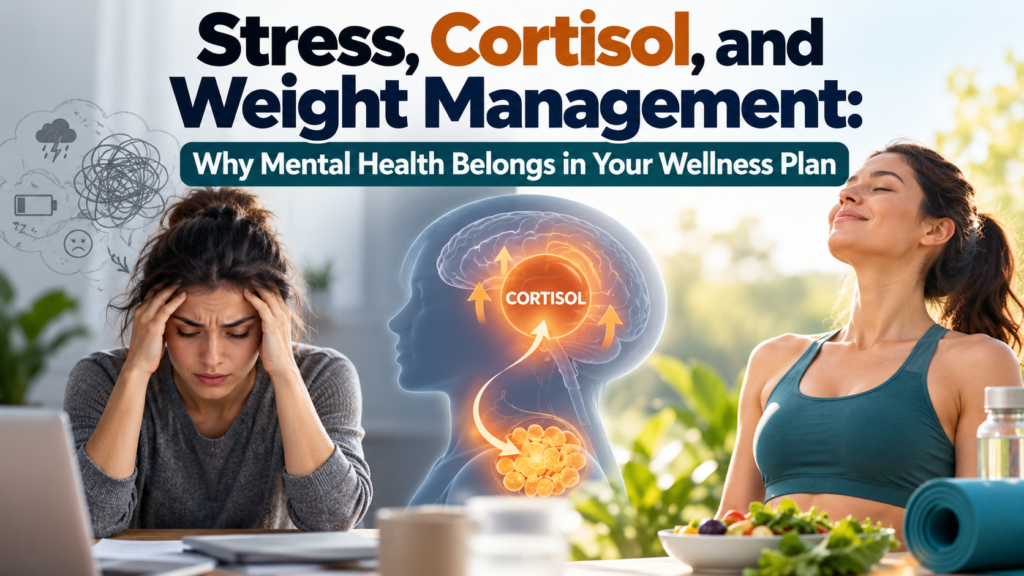
Weight management is often reduced to a simple equation: eat fewer calories, exercise more, and stay disciplined. Your ability to follow a nutrition plan, stay active, sleep consistently, make intentional food choices, and maintain healthy routines can be influenced by much more than willpower.
Stress, emotional health, energy levels, sleep quality, and the way your body responds to everyday demands can all play a role. That is why a whole-person approach to weight management looks beyond food and exercise alone.
At The Wellness Center Health & Therapy, that philosophy is reflected in a connected approach to care that considers physical health, mental health, sleep, energy, weight, movement, and overall quality of life together.
What Happens in Your Body When You Are Stressed?
Stress is a normal physical and emotional response to challenging situations. When your brain recognizes a stressor, your body activates systems designed to help you respond. Part of this response involves hormones, including cortisol.
Cortisol is often talked about as though it is something harmful that needs to be eliminated. But cortisol itself is not the enemy. It is a normal hormone with important functions in the body. During a stressful situation, the stress response helps prepare your body to react to what is happening around you.
The bigger concern is when stress becomes frequent or prolonged without adequate opportunities for recovery. According to the National Center for Complementary and Integrative Health, long-term stress may contribute to or worsen problems such as sleep disturbances, headaches, digestive symptoms, anxiety, and depression.
How Can Chronic Stress Affect Weight Management?
There is no single “stress causes weight gain” pathway that applies to everyone. Instead, stress can influence several interconnected areas of health that may make weight management more difficult.
1. Stress Can Affect Appetite and Eating Patterns
Stress does not affect everyone’s appetite in the same way due to which some people may eat less during periods of stress. Others may notice stronger hunger, cravings, emotional eating, or a greater tendency to reach for convenient, highly palatable foods.
Long-term stress can also involve hormonal responses, including cortisol, that are connected with the regulation of energy and hunger. The CDC recognizes stress as one of many factors that can influence obesity and weight management. This is one reason it can be misleading to view every eating decision as simply a matter of discipline.
Sometimes the more useful question is not:
“Why don’t I have enough willpower?”
It is:
“What is happening around me and within me, when this pattern occurs?”
That shift in perspective can open the door to more practical and sustainable solutions.
2. Stress and Sleep Can Reinforce Each Other
Stress can make it harder to fall asleep, stay asleep, or feel rested. And poor sleep can make an already stressful day more difficult to navigate.
Sleep is not separate from weight management. The CDC includes adequate sleep and stress management alongside nutrition and physical activity as components that support healthy weight loss.
When someone is consistently tired, everyday health behaviors may become harder. Preparing a balanced meal may feel more difficult. Exercise may become less appealing. Energy may drop. Emotional reactions can feel stronger.
Looking at sleep, therefore, is not “going off topic” when discussing weight management. It is part of understanding the whole person.
3. Chronic Stress Can Affect Energy and Daily Decisions
Most wellness plans depend on dozens of small decisions repeated over time.
· Do I prepare a meal or order something convenient?
· Do I go for my planned walk or stay on the couch?
· Do I go to bed or keep scrolling?
· Do I respond to a difficult emotion automatically, or do I have another way to cope with it?
When stress is high and emotional resources feel depleted, consistently making intentional decisions can become more challenging. It means that a sustainable wellness plan should account for the conditions under which those habits need to happen.
If stress is beginning to affect sleep, patience, energy, or your sense of being constantly “on,” explore how The Wellness Center approaches stress support.
4. Emotional Health Can Influence Health Behaviors
Food can sometimes become connected with comfort, distraction, reward, boredom, celebration, or relief from difficult emotions. Repeated behaviors often develop within patterns.
For example:
Stress → poor sleep → low energy → stronger cravings → impulsive food choice → frustration → more stress
Someone may repeatedly try to change the food choice at the end of that chain without addressing everything that happened before it. A whole-person approach asks whether there are earlier points in the pattern where support may be more useful. That is where mental health care and counseling can become relevant.
Where Does Counseling Fit Into Weight Management?
Counseling should not be presented as a way to “remove stress” from someone’s life. Stress is unavoidable and counseling is not a substitute for medical care, nutrition guidance, physical activity, or other appropriate treatments.
Instead, counseling can help people better understand how they respond to difficult situations and develop skills for navigating them.
Depending on an individual’s needs, counseling may help someone:
- Recognize personal stress triggers;
- Identify recurring thoughts, emotions, and behavioral patterns;
- Understand connections between emotions and health behaviors;
- Develop healthier coping strategies;
- Practice emotional regulation skills;
- Create realistic responses to difficult or high-stress situations; and
- Approach setbacks with greater awareness rather than abandoning the entire wellness plan.
The Wellness Center’s counseling services are designed around the same whole-person philosophy, with support for understanding what you are experiencing, building practical tools, and making meaningful changes at your own pace.
The goal is not to create a life without stressful days. It is to develop a plan that can continue to support your health when stressful days happen.
Cortisol Isn’t the Enemy but Chronic Stress Matters
The wellness world sometimes reduces cortisol to a simple message:
High cortisol = weight gain.
Biology is more complicated than that.
Cortisol is necessary for normal body function, and a single cortisol level or a stressful week does not explain someone’s weight or overall health. Body weight is influenced by many interacting factors, including nutrition, physical activity, sleep, medications, health conditions, genetics, environment, stress, and other individual circumstances. The CDC specifically emphasizes that healthy weight management involves more than calories alone.
So instead of trying to “fight cortisol,” a more productive approach is often to ask:
What sources of ongoing stress are affecting my health, and what support would help me respond to them differently?
Weight Management Is More Than a Number on the Scale
This idea connects directly with another important part of whole-person care. Just as mental health should not be separated from physical health, weight management should not be reduced to the number displayed on a scale.
For someone using medical weight-management treatments, including GLP-1 medications when clinically appropriate, medication may support one part of the process but it does not automatically address every factor that influences long-term health.
Nutrition, strength, movement, sleep, emotional wellbeing, stress management, medical monitoring, and sustainable routines may all matter. The Wellness Center’s Medical Weight Management program takes a provider-guided approach that includes medical supervision, lab services, and ongoing support.
Together, these ideas point toward a broader question:
Not simply, “How much weight did I lose?”
But:
“What is happening to my health while I am losing it?”
What Does a Whole-Person Wellness Plan Look Like?
Whole-person care does not mean that everyone needs every service. It means looking at the factors that are relevant to the individual rather than assuming that one intervention can address everything. Depending on someone’s needs, that may involve support for:
· Medical health: evaluating health conditions, medications, symptoms, laboratory results, or other clinical factors.
· Nutrition: building eating patterns that support adequate nourishment and individual health goals.
· Movement: incorporating appropriate physical activity and protecting strength and function.
· Sleep: identifying routines or concerns that may be interfering with restorative sleep.
· Mental and emotional wellbeing: recognizing stressors, emotional patterns, and coping behaviors that affect daily life.
· Counseling: developing practical strategies for managing stress and responding differently to challenging situations.
Your Mental Health Belongs in Your Wellness Plan
At The Wellness Center, whole-person care is built around those connections. Physical health, mental health, medical care, weight management, and lifestyle support are not treated as separate conversations.
If stress is beginning to affect your sleep, energy, mood, or daily habits, explore our approach to stress support and learn how counseling can help you better understand patterns, build healthier coping strategies, and create a plan that is sustainable in real life.
And if weight management is part of your health goals, our Medical Weight Management program looks beyond the scale with provider-guided care and ongoing support.
You can also read GLP-1 Medications and Weight Loss: Why Medication Is Only One Part of the Picture to understand why healthy weight loss involves more than medication or a lower number on the scale.