You may be getting enough sleep, keeping up with your health appointments, and doing your best to take care of yourself. Yet something still feels different.
Maybe you’re having trouble concentrating and might feel mentally tired more often. Or you’ve noticed changes in your memory, focus, or ability to stay on task. When routine lab results don’t explain what you’re experiencing, it can be frustrating to know where to turn.
Your brain health is part of your overall health, and it deserves thoughtful attention, too.
At The Wellness Center Health & Therapy, our Whole-istic Care™ approach considers the different aspects of your health that may be connected.
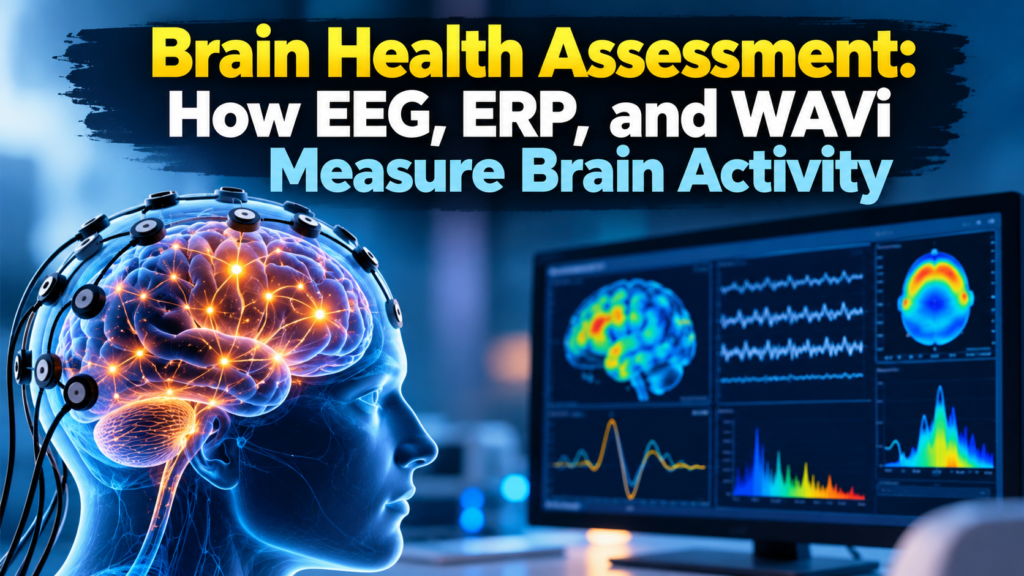
In some situations, our provider may recommend additional assessment to better understand your concerns. Tools such as electroencephalography (EEG), event-related potentials (ERP), and WAVi technology can provide information about certain aspects of the brain’s electrical activity. Let’s discuss what do these tools actually measure, and how might they fit into your care?
Why Brain Health May Need a Different Kind of Assessment
Routine health evaluations can provide important information about your physical well-being. Bloodwork may help identify concerns involving thyroid function, nutritional deficiencies, or other medical conditions. Blood pressure, medication reviews, sleep assessments, and conversations about emotional well-being can also help your provider understand what may be affecting how you feel.
However, routine laboratory testing does not directly measure your brain’s electrical activity. That’s where certain brain assessment tools may provide additional information.
EEG and ERP testing record electrical signals associated with brain activity. Depending on the clinical situation, these measurements may help a provider explore specific questions about neurological function. It’s important to understand that focus, memory, mood, and fatigue can be influenced by many factors, including sleep, stress, medications, mental health, and underlying medical conditions.
Brain activity measurements do not replace an evaluation of those possible contributors. Instead, they may offer another piece of information when clinically appropriate.
What Is a Brain Health Assessment?
A brain health assessment can involve several different steps, depending on your symptoms and your provider’s recommendations. It may include a conversation about your medical history, cognitive concerns, sleep patterns, emotional well-being, medications, and daily routines. In some cases, a provider may also consider tests that measure certain aspects of brain activity.
Two technologies used for this purpose are EEG and ERP.
EEG: Measuring Electrical Activity in the Brain
An electroencephalogram, or EEG, records electrical activity through sensors placed on the scalp. These sensors detect signals associated with activity in groups of brain cells. EEG recordings can provide information about brainwave patterns and the timing of electrical activity.
ERP: Measuring Responses to Specific Stimuli
Event-related potentials, or ERPs, are measurements derived from EEG recordings. They examine changes in electrical activity associated with particular events, such as hearing a sound or seeing an image.
ERP measurements can provide information about how the brain responds during a structured task. Together, EEG and ERP offer different perspectives on brain activity. However, neither test provides a complete picture of a person’s cognitive health on its own.
How Does EEG Measure Brain Activity?
EEG is a noninvasive test that records electrical signals from the brain using electrodes placed on the scalp. During the recording, you may be asked to sit quietly, relax, or follow simple instructions. The sensors collect electrical signals that are displayed as patterns for review.
What Can EEG Show?
EEG is used in healthcare for several established clinical purposes, including evaluating certain neurological conditions. It can also provide information about the timing and patterns of brain activity. One advantage of EEG is that it captures changes in electrical signals very quickly, making it useful for studying activity that occurs over milliseconds. However, EEG has important limitations.
An EEG result does not, by itself, explain why someone is experiencing fatigue, difficulty concentrating, memory changes, or mood concerns.
A normal recording also does not rule out every neurological or cognitive condition. For this reason, EEG findings need to be interpreted alongside symptoms, medical history, examination findings, and other clinically appropriate assessments. At The Wellness Center, we believe information is most useful when it’s considered in the context of the whole person.
What Does ERP Testing Measure?
While EEG records electrical activity, ERP testing looks more specifically at how that activity changes in response to an event. During an ERP assessment, you may be asked to listen for particular sounds, look at visual signals, or complete a simple attention-based task. The recording captures patterns associated with the brain’s response.
Understanding the P300 Response
One ERP component commonly studied in cognitive research is called the P300. The P300 is an electrical response that can occur when a person detects or pays attention to a meaningful or unexpected stimulus. Researchers study aspects of this response, including its timing and amplitude, to better understand certain processes involved in attention and information processing. Although, P300 measurements can vary based on factors such as age, the testing task, attention, and individual differences.
A change in P300 measurements does not automatically mean someone has a cognitive disorder or that a future condition has been detected. ERP findings are best understood as one source of information rather than a standalone diagnosis.
What Is WAVi Brain Health Assessment?
WAVi is a technology platform that uses EEG and ERP measurements to record and organize certain types of brain activity data. The system is designed to make these recordings accessible in participating clinical settings. During an assessment, sensors are placed on the scalp to record electrical activity. You may also complete a structured task involving sounds or other stimuli. The collected information is processed into a report that a provider can review.
What Happens During a WAVi Assessment?
Although the exact process may vary based on your provider’s protocol, an assessment may involve:
- Preparing for the recording: Your provider explains the process and positions the sensors.
- Recording brain activity: The system collects EEG signals during designated portions of the assessment.
- Completing a response task: You may listen to sounds or respond to stimuli while ERP-related activity is recorded.
- Reviewing the results: Your provider considers the available measurements alongside your symptoms and medical history.
The process is generally noninvasive and does not involve surgery.
What Information Can WAVi Provide?
Depending on the assessment protocol, WAVi may provide measurements related to brainwave activity and certain responses to stimuli. These results may offer additional information for discussion with your provider. However, WAVi does not independently diagnose the cause of memory problems, attention difficulties, fatigue, or other health concerns.
It should not replace a comprehensive clinical evaluation or established diagnostic testing when those are needed. You can learn more about the assessment options available through our Diagnostic Testing services.
How Do Providers Interpret Brain Health Assessment Results?
Brain Health test results are only one part of understanding your health. Two people may experience similar concerns with focus or memory for very different reasons. For example, one person may be dealing with disrupted sleep and ongoing stress. Another may be experiencing medication effects or symptoms associated with an underlying medical condition. A provider-guided assessment helps place the available information in context.
When reviewing EEG, ERP, or WAVi results, a provider may consider:
- Your current symptoms and concerns
- Your medical and family history
- Your sleep patterns and daily routines
- Your emotional well-being and stress levels
- Current medications and supplements
- Other examination findings or test results
- Whether further evaluation or referral is appropriate
This approach helps avoid making conclusions from a single measurement. It also creates space to discuss what the results can and cannot tell you.
Brain activity data may help inform a conversation about your health, but it does not replace clinical judgment.
Can Brain Health Assessments Be Repeated Over Time?
In some situations, our team might ask you to repeat assessments to compare measurements collected at different points in time. Having an earlier recording may provide a reference for future results. Although, changes between recordings do not always indicate a meaningful change in brain health.
EEG and ERP measurements can be influenced by testing conditions, alertness, task performance, and other factors. For that reason, comparing results over time requires careful interpretation.
Why a Baseline May Be Helpful
A baseline measurement provides information about a particular point in time. If a repeat assessment is clinically appropriate, your provider may review whether measurements differ and consider what those differences might mean. But a baseline does not predict future cognitive health, and repeat testing is not necessary for everyone.
The value of follow-up testing depends on the clinical question being asked, not simply on collecting more data.
How Brain Health Fits Into Whole-istic Care™
Your brain doesn’t function separately from the rest of your body. Sleep, stress, nutrition, medications, physical health, and emotional well-being can all influence how you think and feel. That’s why brain health concerns deserve an approach that considers more than one symptom or test result.
At The Wellness Center Health & Therapy, our Whole-istic Care™ approach starts with listening to your experience and understanding what may be contributing to your concerns. If you’re noticing changes in focus, memory, or mental energy, your provider may explore several possible factors before deciding whether additional testing is appropriate.
Depending on your needs, your care may involve Primary Care, diagnostic testing, or other services. The goal is to connect the different pieces of your health rather than treating each concern in isolation.
When Should You Talk to Our Provider About Brain Health Concerns?
Occasional forgetfulness or difficulty concentrating can happen for many reasons. Although, if changes in your memory, attention, or thinking are persistent, worsening, or affecting daily life, it’s worth discussing them with a healthcare professional.
You may want to schedule a conversation if you’re experiencing:
- Ongoing difficulty concentrating
- Noticeable changes in memory
- Mental fatigue that interferes with daily activities
- Concerns about attention or information processing
- Cognitive changes that feel different from your usual experience
These symptoms do not necessarily mean you need an EEG, ERP, or WAVi assessment. We can help you to determine which evaluation, if any, is appropriate. Sudden confusion, new difficulty speaking, facial drooping, or weakness on one side of the body requires emergency medical attention rather than a routine brain health appointment.
At The Wellness Center Health & Therapy, we believe care should begin with listening, thoughtful assessment, and a plan that considers the whole you.
Schedule a Visit about what you’ve been experiencing and find the next right step for your care.
Frequently Asked Questions About EEG, ERP, and WAVi
Is a WAVi Assessment the Same as an EEG?
Not exactly. EEG is the method used to record electrical activity from the brain. WAVi is a technology platform that uses EEG and ERP recordings as part of its assessment process.
Can WAVi Diagnose ADHD, Dementia, or Other Cognitive Conditions?
WAVi measurements alone cannot establish these diagnoses. Conditions involving attention, memory, or cognitive changes require an appropriate clinical evaluation, which may include other assessments or referrals.
Is EEG Testing Painful?
EEG recording is generally noninvasive and painless. Sensors are placed on the scalp to detect electrical activity rather than deliver electrical stimulation into the brain.
Can EEG or ERP Explain Why I Feel Mentally Tired?
Not on their own. Mental fatigue can have many contributors, including poor sleep, stress, medication effects, and medical conditions. Your provider can determine whether brain activity testing is relevant to your symptoms.
Does Everyone Need a Baseline Brain Health Assessment?
No. Whether a baseline EEG or ERP assessment is useful depends on your circumstances and the clinical purpose of testing.
Can WAVi Results Be Compared Over Time?
Certain measurements may be compared across assessments, depending on the system and testing protocol. Your provider should interpret any differences in context rather than assuming that a change automatically represents improvement or decline.