
We’ve been diagnosing mental health conditions the same way for decades. A patient sits across from a clinician, describes their symptoms, and the clinician checks boxes on a standardized questionnaire. You can’t focus? Check. You feel anxious? Check. You’re exhausted but can’t sleep? Check.
The problem is that subjective assessments only capture what patients can articulate, and what they can articulate often doesn’t match what’s actually happening in their brains.
Research confirms this disconnect. A landmark study of 57 outpatients with major depressive disorder found that objective and subjective cognition in patients with depression are not correlated. What patients think is happening in their brains doesn’t match the neurological reality.
This is where quantitative electroencephalography (qEEG) changes the conversation. It measures electrical activity in your brain in real time, revealing patterns that symptom checklists miss entirely.
The Fundamental Problem With Symptom-Based Diagnosis
Traditional mental health diagnostic methods rely on patient self-reporting and clinical interpretation. You describe how you feel. The clinician interprets what you say. A diagnosis emerges from that subjective exchange.
But here’s what we see in practice: people often don’t know what’s going on in their brain.
They attribute brain slowing to being “just tired” or having “brain fog.” They’ve normalized their symptoms because they’ve lived with them for years. When we show them the qEEG data, they’re surprised to discover there’s measurable slowing in their brain processing, or dysregulation in their brainwave patterns.
A 2025 study published in Frontiers in Human Neuroscience confirms that diagnostic methods based on subjective assessments “limit their reliability and lead to an incomplete reflection of the patient’s real condition.” The reliance on patient symptoms and clinician interpretation implants the seeds of diagnostic unreliability in psychiatric disorders.
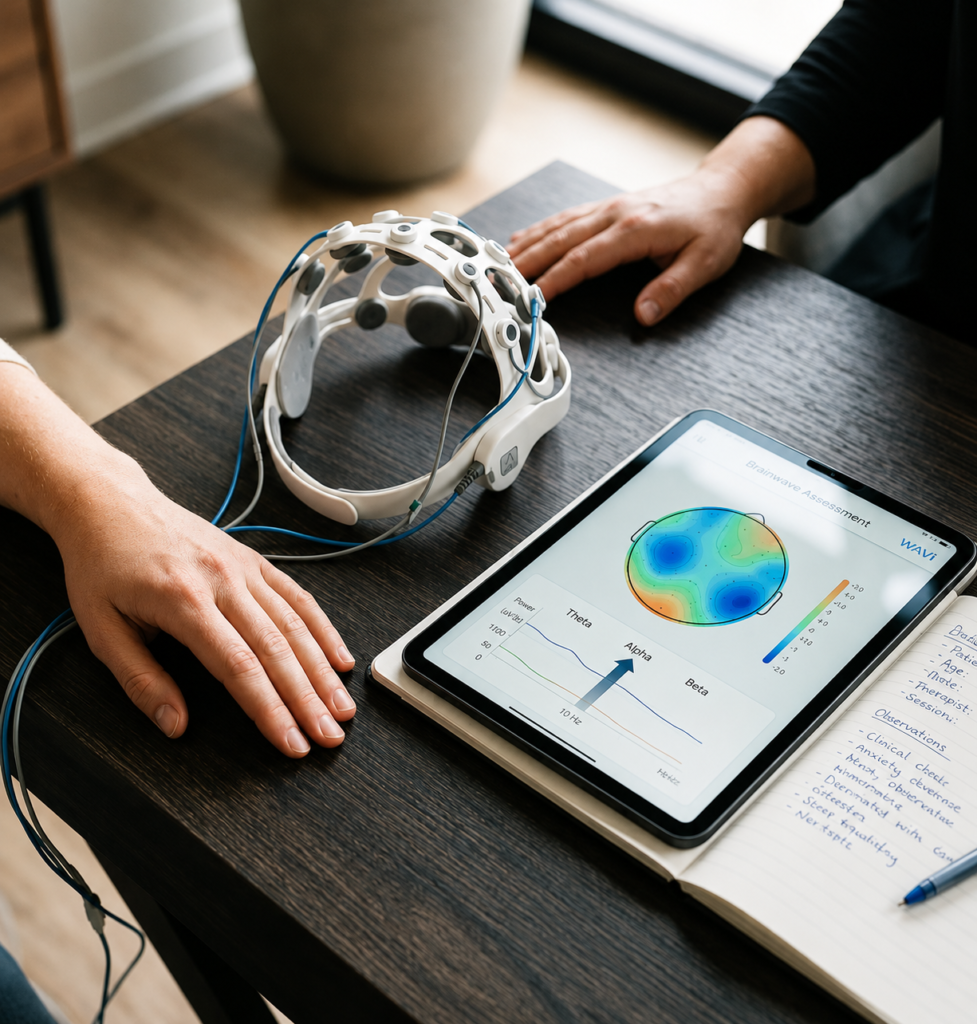
The WAVI-qEEG brain assessment provides objective data. It’s fast, non-invasive testing that measures how your brain is functioning right now using electrical activity. The goal is to assess brain performance and neurological function, identifying slowed brain processing, dysregulation in brain waves, cognitive inefficiencies, and early signs of neurological decline.
This becomes clinically helpful for people showing mental health patterns like anxiety, depression, and ADHD. It’s also valuable in functional and integrative medicine for brain fog, chronic fatigue, high stress, and cortisol dysregulation, as well as performance optimization for athletes tracking reaction time and recovery.
What The Data Actually Shows You
The qEEG assessment displays brain function as a colored graph with target ranges and arrows. The arrows should fall within the target ranges. When they don’t, you see specific patterns:
Brain power measurements can reveal concussion effects, depression, or anxiety patterns.
Brain speed indicators show cognitive impairment, poor cardiovascular fitness, age-related changes, memory loss, or neurological conditions.
Physical reaction time data tracks power and speed in relation to the body, which may decline with factors like age, fatigue, concussion, Parkinson’s, executive function challenges, and Alzheimer’s.
The theta-beta ratio reveals ADHD traits by showing the relationship between slow, free-thinking theta brain waves and fast-focused beta brain waves.
This visual evidence helps people make informed decisions about their brain healthcare. Some choose medication. In our practice, we encourage holistic approaches to help regulate and bring the brain back to normal function without side effects.
The Hypervigilant Fatigue Loop
Most people think of ADHD as simply “can’t focus” or “hyperactive.” The behavioral symptoms tell one story. The brain data tells another.
Here’s where the WAVI-qEEG becomes clinically useful instead of just descriptive: the theta-beta imbalance reveals a brain that is under-aroused AND over-aroused at the same time.
When theta waves are elevated, the brain is under-aroused. It’s foggy, fatigued, insufficient, and underpowered. The person struggles with focus and experiences mental drift.
When beta waves are elevated, the brain is over-aroused. It’s scanning, over-processing, and on edge. The person deals with mental overactivity, stress, and anxiety.
When both are elevated simultaneously, you have mixed dysregulation. The person feels:
- Wired and exhausted
- Anxious and unable to focus
- Mentally busy but unproductive
- Foggy with drifting thoughts
- Reduced thinking or overthinking
- Anxiety spikes
- Poor sleep quality
We call this the hypervigilant fatigue loop.
This phrase matters because it reframes the entire story the patient has been told about themselves. The common misconception is binary: you’re either anxious (overactivation) or you have ADHD (underactivation).
But the brain data shows both are happening simultaneously. The real issue isn’t that you have too much energy or not enough energy. It’s a dysregulation of energy.
Research confirms this complexity. A 2023 study found that subjects with ADHD symptoms and low working memory performance present higher theta-beta ratios than controls, but critically, the ADHD population is not homogeneous. Different subgroups show completely different brainwave patterns, meaning the label “ADHD” masks neurological diversity that requires different treatments.
Why Stimulants Can Tighten The Loop
ADHD medication works by increasing dopamine, which helps motivation, reward, and focus. It also increases norepinephrine, which helps alertness, attention, and executive function. In simple terms, it turns up the signal strength in the brain, especially in the prefrontal cortex, helping with focus, task completion, and impulse control.
The side effects stem from overactivation:
- Decreased appetite
- Insomnia
- Increased heart rate and blood pressure
- Anxiety or jitteriness
- Irritability
- Headaches
- Emotional blunting
- Dependence or tolerance
- Worsening anxiety, especially in the hypervigilant brain
- Crash fatigue cycles
The key clinical issue: the stimulant improves short-term focus, but pushes the beta waves even higher, causing more internal stress.
You may hear a patient say, “I can focus better, but I feel more on edge.” That’s the loop getting tighter.
This comes up more often than people expect, especially in adults who’ve been on stimulants for years. We don’t want patients to feel they’ve done anything wrong or that their treatment was wrong. We want them to understand we have more information now about what the brain needs.
Some patients remain on the medications and add neurofeedback. Others reduce the meds gradually, realizing the medication masks a deeper issue. Your brain data often shows they didn’t need stimulation—they needed regulation.
How Neurofeedback Retrains The Brain
The conservative approach to mixed dysregulation is neurofeedback. It works by teaching the brain to self-correct rather than overriding it.
The core difference:
ADHD medication increases brain activity so you can function better right now. It’s a temporary override.
Neurofeedback retrains your brain so it doesn’t need to struggle in the first place. It addresses the root problem and builds long-term regulation.
The results are more gradual, but they target the actual dysregulation pattern. A 2025 meta-analysis of 17 randomized controlled trials involving 939 children with ADHD found significant improvements in global executive function, inhibitory control, and working memory following neurofeedback training. More importantly, the evidence suggests that neurofeedback may have sustained effects on both working memory and inhibitory control.
We also use supplementation for neurotransmitters (vitamins and herbal options), IV therapies, the neuro-optimal machine (a neurofeedback device), and TMS. All of these help regenerate the function and balance of the brain.
People can also implement strategies at home: brain games, music, prayer, meditation, delta waves, and cardiovascular work. All of these support brain function and improvement.
Specific treatments for the hypervigilant fatigue loop include neurofeedback, supplementation, acupuncture, vagal nerve work, breathing exercises, massage, and exercise. We provide information on all of these or perform them in the office.
The Diagnostic Precision qEEG Provides
Recent validation studies demonstrate qEEG’s capacity for objective differentiation that symptom checklists can’t achieve. A 2025 study found that selected EEG and qEEG parameters can distinguish individuals with depression from healthy controls with high accuracy. The use of the Phase Lag Index (PLI) achieved a classification accuracy of over 80%.
For anxiety disorders, researchers found specific patterns: low contribution of sensorimotor rhythm (SMR) wave amplitudes and high beta2 wave amplitudes, higher or equal to the alpha amplitudes. This provides clinicians with quantifiable, reproducible data rather than subjective interpretation.
That said, researchers emphasize there’s still a lack of standardized procedures and analysis protocols, which limits practical application in widespread clinical diagnostics. The American Academy of Neurology and American Clinical Neurophysiology Society acknowledge that while qEEG currently remains experimental for many psychiatric conditions, it’s already complementary to conventional EEG in multiple clinical scenarios.
The role of qEEG is not to pinpoint an immediate diagnosis. It provides additional insight in conjunction with other diagnostic evaluations to offer objective information necessary for obtaining a precise diagnosis, correct disease severity assessment, and specific treatment.
What Changes When Brain Data Becomes Standard Practice
When objective data like qEEG becomes standard, it doesn’t just improve mental healthcare. It fundamentally changes what the field is capable of doing.
Right now, most care is built on symptom clustering. You fill out a checklist, you fit into a category, here’s the protocol.
With brain data, you move into pattern-based medicine. Your brain is doing this specific thing, here’s what it needs specifically.
This takes us from guessing into precision. What becomes possible:
- We can treat the actual physiology, not the label
- Fewer failed medication trials
- Faster clinical wins
- Personalized treatment protocols based on measurable brain patterns
- The ability to track treatment efficacy with objective data
The biggest shift for patients: right now, you’re often labeled as anxious, ADHD, or depressed. With brain data, the story becomes: your brain is currently in this pattern, and patterns can change.
That’s empowering. It’s also the truth.
We hope more people can take advantage of this approach as it becomes more accessible. The technology exists. The research supports it. What’s needed now is wider adoption and standardization so objective brain data becomes the foundation of mental healthcare rather than the exception.