
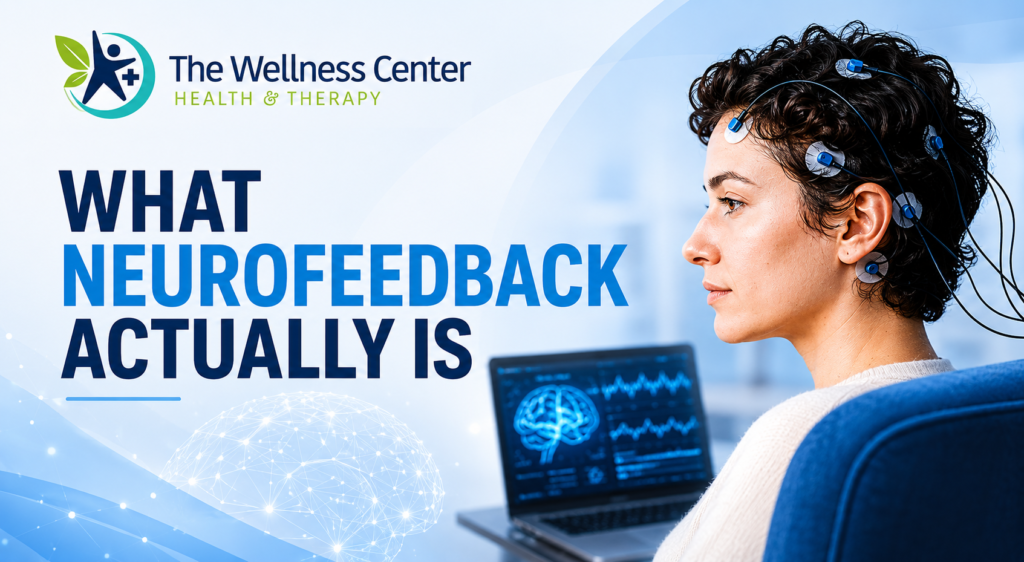
Think of neurofeedback as a workout for your brain. But instead of lifting weights, your brain learns to regulate its own electrical activity through real-time feedback.
We’re not putting anything into your brain. We’re not forcing it to do anything. We’re simply measuring what it’s already doing and letting it see itself more clearly so it can adjust on its own.
This is neurofeedback in its simplest form: biofeedback for brain function.
The Science Behind How Your Brain Learns Without Trying
Your brain is constantly asking itself: “What just worked? What didn’t?”
Even when you’re not aware of it, your brain is predicting and adjusting. When neurofeedback gives a reward—the movie on screen plays smoothly, the music becomes fuller and clearer—your brain detects a pattern.
That pattern equals a good outcome.
Here’s what happens neurologically:
When that positive feedback occurs, your brain releases small amounts of dopamine. That dopamine acts like a tagging system, essentially telling your brain: “Save this pattern. Do this again.”
This is the same mechanism behind learning anything—skills, habits, even addiction. Neurofeedback works through operant conditioning, where the brain receives positive feedback when it produces healthier patterns, and dopamine reinforcement helps tag these patterns for repetition.
Through repetition, you get neuroplasticity:
- Helpful brainwave patterns get reinforced
- Inefficient or dysregulated patterns fade from lack of reward
It’s literally “neurons that fire together, wire together.”
The brain naturally prefers less energy use, more stability, and better regulation. So once it discovers a more efficient pattern, it starts defaulting to it.
Research shows that just half an hour of voluntary brain rhythm control led to lasting shifts in cortical excitability that persisted for at least twenty minutes—evidence of neuroplastic changes occurring after brainwave training.
What Actually Happens in a Session
Walk into a neurofeedback clinic and you’ll sit in a comfortable chair. Nothing clinical or intimidating.
The first thing you’ll hear: “You can just relax. This isn’t something you have to try at.”
No performance pressure. That matters more than you’d think.
The Setup (3-5 minutes)
A couple of sensors get placed on your scalp, usually with a little paste. Ear clips go on. That’s it.
What you’ll feel: Slight coolness from the paste. Otherwise, nothing.
No electricity goes into your brain. This is read-only—like a heart monitor for your brain activity.
The Session (30-33 minutes)
You watch a movie or listen to music with your eyes closed.
When your brain starts working in a healthier, more balanced way, it gets rewarded. If you’re watching a movie, the screen gets bigger or clearer. If you’re listening to music, the sound becomes fuller and smoother.
Your brain notices. It learns. And over time, it stays in that better pattern on its own.
The Paradox of Trying
Some people try to control it. They try to relax harder, focus intensely, or figure out the pattern that makes the screen get bigger.
That effort usually adds noise and instability.
When you engage the thinking/effort network in your prefrontal cortex, it can override your brain’s natural self-regulation process. It becomes like trying to fall asleep by trying harder.
When someone just relaxes—stops trying to control anything, lets their mind wander, passively watches or listens—the brain settles into more natural rhythms. Self-corrects more efficiently. Shows smoother, more stable patterns.
The learning happens faster and more cleanly.
The less you try to control it, the more your brain can do what it already knows how to do: self-correct.
What Neurofeedback Treats (And What It Doesn’t)
Not all conditions respond the same way. Some show consistent improvement. Others remain unpredictable.
Conditions That Respond Most Consistently
Attention issues (especially dysregulated focus)
ADHD—particularly combined or inattentive types—responds well because you’re directly training timing, arousal, and regulation. These are core issues in attention.
Meta-analyses found large effect sizes for improving impulsivity and inattention, and medium effect sizes for hyperactivity. In November 2012, the American Academy of Pediatrics designated neurofeedback as a Level 1 or “best support” treatment option for children with ADHD.
What you’ll see: Better sustained focus, less mental drift, improved task completion.
Anxiety and overactive nervous systems
Generalized anxiety, high baseline stress, the “can’t turn my brain off” feeling—these respond because you’re helping the brain exit chronic hypervigilance and regain flexibility.
Common wins: Faster calming, less reactivity, improved sleep.
Sleep dysregulation
Trouble falling asleep, frequent waking, non-restorative sleep—sleep is one of the most sensitive indicators of brain regulation.
Sleep often improves early, even before other symptoms.
Post-concussion and mild traumatic brain injury
Brain fog, head pressure, sensory sensitivity—the brain has clear dysregulation but also strong capacity to reorganize.
This group often says: “I finally feel like myself again.”
Stress-driven chronic pain patterns
Not structural damage, but nervous system-driven pain. You’re reducing central sensitization and improving regulation.
Results: Less flare intensity, better recovery after stress.
Mixed or Variable Responders
Trauma and PTSD
Can respond very well, but needs careful pacing. Can stir up symptoms initially. Requires strong patient trust.
Not a quick win, but can be powerful long-term.
Depression
Works better when there’s agitation, anxiety, or sleep issues. Less consistent in flat, low-energy depression.
“Wired and tired” shows better response. “Shut down and numb” is slower and less predictable.
Where Expectations Often Exceed Results
This is the part most clinics avoid talking about.
Highly structural or degenerative conditions
Advanced neurodegeneration, significant structural brain damage—you can improve regulation, but you can’t rebuild damaged tissue.
Severe, complex psychiatric conditions
Certain personality disorders, severe unstable mood disorders—dysregulation is multifactorial, not just brainwave patterns.
Patients looking for a passive miracle cure
This is the biggest predictor of disappointment, not diagnosis.
Red flags: “Fix me without changing anything else.” Poor sleep, high alcohol use, chronic stress—but unwilling to address them.
Neurofeedback helps the brain, but the environment still matters.
People who expect dramatic immediate results
Even when it’s working, changes can be subtle at first. They may miss early improvements.
Why Sleep Improves First
Sleep depends on very fundamental systems: arousal versus calm balance, timing and rhythms, nervous system stability.
These are largely governed by deep brain structures and the autonomic nervous system. Neurofeedback directly influences these regulation systems.
So when the brain starts organizing better, sleep is often the first place it shows up.
A lot of people walk around in low-grade fight-or-flight, a constant mental “on” state—even if they don’t feel anxious. Neurofeedback helps the brain downshift out of that state more easily.
Which makes it easier to fall asleep, stay asleep, and enter deeper sleep cycles.
Sleep requires less “performance” than daytime function. Improving focus, mood, and behavior requires complex, waking brain networks. But sleep is more automatic.
So it’s easier for the brain to improve sleep before it improves higher-level functions.
Early Signs It’s Working (And When to Reassess)
How do you know within the first few sessions whether neurofeedback will help?
The Strongest Early Predictors
Sleep shifts (the number one predictor)
Even subtle changes count: falling asleep easier, sleeping deeper, fewer wake-ups, feeling more rested.
This is your strongest early green light.
State shifts—even if symptoms aren’t “fixed” yet
“I feel a little calmer.” “Things don’t bother me as much.” “My brain feels quieter.”
That tells you regulation is improving underneath the surface.
More variability instead of being “stuck”
This one is counterintuitive but huge.
Before: Same symptoms, same intensity, all day.
After a few sessions: Good days and bad days. Symptoms come and go. Windows of feeling better.
That variability means the brain is becoming less rigid and more adaptable.
Subtle functional wins
Not dramatic, but meaningful: slightly better focus, less reactivity in conversations, faster recovery after stress, less overwhelm.
Patients often underreport these. You have to pull it out of them.
“I don’t know… something’s different”
This is actually a great sign.
When patients can’t clearly label it but feel a shift, that’s early system-level change.
When to Have the Conversation
Before 5 sessions, it’s too early. Many brains are just warming up.
By sessions 6-10, you should see something, even if it’s subtle.
After 10+ sessions with zero signal, it’s time to reassess openly.
Most clinicians start softening the ground around session 6-7: “We should be seeing early signs by now. Let’s look closely at what’s changing and what’s not.”
Then by session 8-10: “I’m not seeing the response I’d expect yet. Let’s talk about why and whether we pivot.”
The Realistic Timeline for Change
Phase 1: Early shifts (Sessions 1-5)
Sleep changes, subtle calm or focus shifts, slight variability.
Patient reaction: “Something’s a little different…”
Phase 2: Noticeable changes (Sessions 6-10)
This is where it starts crossing into: “Okay, this might actually be doing something.”
They’ll notice: reacting less in situations that normally trigger them, better recovery after stress, more consistent energy, moments of clear thinking.
Still not life-changing, but now it’s real and repeatable.
Phase 3: Functional change (Sessions 10-20)
This is where patients say: “Okay, this is actually affecting my daily life.”
Examples: “I handled that situation totally differently.” “I’m getting through my workday without crashing.” “I’m not snapping at people like I used to.” “My anxiety isn’t running the show anymore.”
The difference here: It’s no longer internal only. It’s showing up in behavior and life.
Most people begin noticing subtle changes like improved sleep, reduced anxiety, or sharper focus after 5-10 sessions, with meaningful functional changes typically appearing between sessions 10-20.
Phase 4: Stabilization (Sessions 20-40+)
Now you’re seeing: consistency, resilience under stress, less backsliding.
This is where it becomes their new normal, not a temporary improvement.
For lasting results, 30-40 sessions are commonly recommended, though this varies by individual and condition severity.
What Accelerates Progress (And What Undermines It)
Neurofeedback helps the brain, but the environment still matters.
Things That Accelerate Progress
Sleep consistency (the biggest multiplier)
If you fix only one thing, it’s this.
Sleep is where neuroplasticity actually gets stabilized. It supports stable circadian rhythm, better consolidation of brain changes, and faster integration of new regulation patterns.
Predictable daily rhythm
Regular wake time, consistent meals, structured work and rest cycles.
The brain learns faster when the environment is not chaotic.
Moderate physical activity
Walking, light strength training, zone 2 cardio.
Why it helps: improves autonomic flexibility, reduces baseline stress tone, enhances brain-derived growth signaling.
Low-to-moderate stress exposure with recovery
Not “no stress,” but stress plus recovery cycles.
The brain learns regulation in cycles, not in constant activation.
Good hydration and stable blood sugar
This sounds simple, but it matters: fewer energy crashes, less sympathetic overactivation, more stable attention and mood baseline.
Supportive emotional environment
Less conflict at home or work. Feeling safe and not constantly judged.
Safety is a prerequisite for regulation change.
Things That Undermine or Slow Progress
Chronic sleep deprivation
This is the biggest derailment factor.
Effects: prevents consolidation of new patterns, keeps the brain in survival mode, masks subtle improvements.
You can’t train a system that never gets recovery time.
High sustained stress without recovery
Toxic work environments, caregiving overload, ongoing emotional conflict.
This keeps the brain locked in a high-arousal state, interfering with regulation change.
Alcohol, especially regular use
Even moderate use can disrupt sleep architecture, reduce neural integration, and flatten neuroplastic response.
Overstimulation lifestyle
Constant phone use, multitasking all day, no downtime, high screen exposure late at night.
This keeps the nervous system jacked up and less adaptable.
Emotional invalidation environments
If you’re constantly criticized, not emotionally safe, or always in conflict, the brain prioritizes protection over learning.
Inconsistent attendance
Neurofeedback works best with repetition, pattern reinforcement, and nervous system stacking over time.
Long gaps can reset progress.
How Neurofeedback Fits With Other Treatments
Most people think of neurofeedback as a standalone treatment. It’s not.
Therapy (CBT, Somatic Therapy, Trauma Therapy)
Works very well together.
Why: Neurofeedback reduces physiological noise. Therapy builds insight, skills, and meaning.
In simple terms: Neurofeedback equals state regulation. Therapy equals thoughts plus behavior change.
What improves when combined: better emotional tolerance in sessions, faster insight processing, less overwhelm during trauma work, reduced resistance and defensiveness.
Best pairings: trauma-focused therapy like EMDR or somatic work, CBT for anxiety or depression, skills-based coaching for ADHD.
Potential mismatch: If therapy is very insight-heavy but the nervous system is still highly dysregulated, patients “understand everything” but don’t change behavior.
Neurofeedback can unlock that bottleneck.
Medication
Works well, but depends on the goal.
When it works well together: ADHD meds plus neurofeedback gives focus plus regulation support. SSRIs plus neurofeedback gives emotional stabilization plus flexibility. Sleep meds plus neurofeedback provides short-term support while retraining sleep systems.
Key principle: Medication changes state. Neurofeedback changes capacity.
Potential friction cases: over-sedation can reduce learning responsiveness. High stimulant doses create an artificially driven nervous system that resists settling.
Lifestyle Interventions
This is where outcomes are often won or lost.
Strong synergy with neurofeedback: sleep hygiene, exercise, stress reduction, nutrition stability, breathwork and vagal regulation practices.
Why it matters: These reinforce the same system neurofeedback is training—autonomic balance, rhythm stability, recovery capacity.
If lifestyle is poor, neurofeedback may still work, but you’ll see slower progress, shorter-lived gains, and more plateauing.
What Doesn’t Combine Well
Chronic overstimulation lifestyle—high screen exposure, constant multitasking, no recovery time. This competes directly with the brain’s ability to stabilize.
Substance-heavy patterns—alcohol, cannabis in some patients, sedative reliance without structure. Can blunt or distort neuroplastic learning.
Pure “talk-only” expectation without regulation support—if someone expects therapy alone to change panic, trauma reactivity, or focus instability, neurofeedback can be the missing regulation layer.
How to Find Quality Neurofeedback
If you’re thinking “maybe this could help me,” here’s what to look for in a provider or clinic.
They Focus on Assessment and Fit, Not Selling Sessions
A quality provider will ask detailed history: sleep, stress, trauma, medications, lifestyle. Screen for whether neurofeedback is appropriate. Set realistic expectations up front.
🚩 Red flag: “This works for everyone” or pushing packages immediately.
They Talk About Progress Markers Early
Good clinicians don’t wait until session 20 to evaluate.
They track sleep changes, energy shifts, emotional reactivity, and function in daily life. And they reassess within the first 5-10 sessions.
They Don’t Overpromise Outcomes
Realistic language sounds like: “Most people notice subtle shifts first.” “We’re looking for trends, not instant fixes.” “Your brain’s response will guide us.”
🚩 Red flag: Guaranteed results, “reprogram your brain fast,” or miracle claims.
They Integrate, Not Isolate Treatment
Good clinics understand neurofeedback is part of a system: therapy, sleep and lifestyle changes, sometimes medication coordination.
If a clinic treats neurofeedback as the only answer, that’s a warning sign.
They Can Explain What They’re Doing in Plain Language
You should hear something like: “We’re helping your brain improve self-regulation through feedback signals.”
Not overly mystical language, overly technical jargon no one can follow, or vague “energy balancing” explanations without clarity.
They Monitor for Both Improvement and Lack of Response
A good provider will say: “We’re seeing early signs of progress” or “We’re not seeing expected changes yet—let’s reassess.”
🚩 Red flag: Continuing indefinitely without any evaluation or adjustment.
They Respect Timing and Pacing
Quality neurofeedback is not rushed. Sessions are spaced appropriately. They don’t push excessive frequency without reason. They understand nervous system fatigue and adaptation.
They Are Honest About Limitations
A strong clinician will tell you: not every condition responds equally, some cases require other interventions first, lifestyle factors matter significantly.
This honesty is one of the strongest trust signals.
What You Should Understand Before You Start
Neurofeedback isn’t about creating a new brain.
It’s about helping the brain access its own capacity to stabilize and organize itself more efficiently.
We’re not putting something into your brain. We’re helping your brain see itself more clearly so it can adjust on its own.
When people understand this, they stop over-controlling sessions. They stop expecting instant transformation. They become better observers of subtle change.
And paradoxically, they often improve faster.